shhhhh…

!!!
Fade the thoughts
Until they numb,
Closing in upon themselves
Killing off feeling
!!!

Cracked Bell

you,

you write older than you are

as if

the ink in your veins

was of another era

she said

why bother with words

only the dead would love?

but I kept typing

on and on and on

without listening

because I like the dead and their ways

they remain in silence

they let each word fill the void

like peals from a cracked bell

ringing in a broken cacophony

as best it can

til it falls through the tower

to the ground below

and rests

i miss her laugh

i knew a broken lioness
covered inside and out with the scars
of a life lived at the end of other’s fists

i knew a battered lioness
blackened by the brutality of a mad world
that sought to tear her to pieces

i knew brave lioness
who stepped between the hurled hate
and the cubs she loved – every time

and i miss her laugh her laugh her laugh,
i miss her presence in the wasted world;
she bled her love into us – me and mine
and i miss her laugh…

Nokia Lumia 830 Windows Mobile: Review

Ok Microsoft – I’ve had it with your piece of shit phone. It sucks ass. It is the worst mobile device I have ever owned (and that is saying something) and I’m stuck with the damned thing for at least another year.

It’s my own fault. The guy at MTS tried to talk me out of it but nooooo I wouldn’t listen. I was all “Hey man, Microsoft makes great products…I’ve have always been a Microsoft man and this phone has some awesome specs and a kick-ass camera” and he was like “dude are you SURE you want this? Microsoft is going to stop supporting it, there’s like no apps for it at all” and I was like “give them time man…Microsoft has had issues before sure but they spent like a bazillion dollars on Nokia which would be the ultimate in STUPID if they were just going to throw it all away with crap support and no long-term strategy.”

Geez was I sooooo wrong. Microsoft took a great phone company and absolutely destroyed it.

The real kicker here is the Nokia Lumia 830 is a FUCKING BEAUTIFUL phone. REALLY nice design with a wonderful metal frame and interchangeable snap on backs in different colours, wireless charging, a freaking Karl Zeiss optics based camera, a Micro SD card slot for expansion etc.

Hardware is awesome – but then Microsoft came along and crammed their corporate ass up against the phone and filled it with SHIT.

At first I thought that Windows 10 Mobile would be the beginning of significant improvement…once again WRONG. NOTHING WORKS. NOTHING.

This is not an exaggeration – every time one thing starts working another stops.  I was just learning to love the awesome swipe style key pad and BOOM – stopped working. All tap all the time now and no fixes anywhere.

Apps stop working in mid use and vanish for no reason. Texts will show up hours late or not at all. Lately when I push the camera button while the phone is at rest the screen goes into an on-off fit until I physically power on with the power button and tap the Windows button.

Did I mention there are no apps for it? Oh there are tones of apps – just nothing that anyone wants to use and more keep dropping out every day.

The good news is it seems to manage phone calls reasonably well (which shouldn’t feel like a plus with a mobile phone).

All in all this is my fault…I was warned in all the research I did. I was warned by friends. I was warned by the sales guy at the phone store…

…and now I’m warning you…don’t buy one. Unless things significantly change in terms of app support and OS it would be a HUGE mistake.

Who knows – maybe they’ll support Android before my year is up…

Truth is Dead.

Post-truth

According to Oxford – ADJECTIVE

  • Relating to or denoting circumstances in which objective facts are less influential in shaping public opinion than appeals to emotion and personal belief:

    ‘in this era of post-truth politics, it’s easy to cherry-pick data and come to whatever conclusion you desire’
    ‘some commentators have observed that we are living in a post-truth age’


I lament the loss of truth.

Maybe I lament the loss of our ability to find truth or believe in its existence.

Either way I am in mourning.

Nothing is true anymore (as evidenced by the rise of websites like Snopes). It is in fashion to be contrary and to call out anyone who takes a stand on anything or simple believes anything.

“I love how blue the sky is”

“It’s not really blue but actually azure”

“I’m voting for…”

“S/he’s an idiot”

“I can’t get enough of new chocolate”

“It’s not really chocolate you know”

“This new coffee from Africa is amazing”

“You know their harvesting practices kill babies right?”

Forever and onward it goes. Everything sucks. The world is horrible, and, most importantly – nothing you say is accurate or true.

What this does is immobilize things. A “nobody moves and nobody gets hurt” mentality develops and everything grinds to a halt as the fanboys and girls who worship entropy bow down in ecstasy over how chaotic and conflict-oriented everyone and everything is becoming.

I miss truth. Even if it wasn’t true I miss days when decisions could be made. These days people are paralyzed by the smallest decisions for fear they might be wrong instead of simply moving forward and accepting the consequences. There’s a lot of “you can’t do that” but very little in the way of “maybe you should do this” or even a solid explanation as to why you cannot do something.

Make decisions based on what you believe. Sure you will screw up (loads) – guaranteed. It is easy to predict failure. Ignore the predictions and forge ahead. Be one of the few not rabidly fixated on tearing down and apart everything everyone does and says and simply move forward. Accept responsibility for your mistakes and learn from them – but let yourself make them for heaven’s sake.

Manitoba Municipal Spending Watch (not as boring as it sounds…ok maybe it is but you should still read it…)

Instead of reading a lot of the extreme left and right garbage flying around social media how about reading something potentially useful and informative for a few minutes – like this post on the 3rd Manitoba Municipal Spending Watch.

A report from the Canadian Federation of Independent Business (CFIB)  released this week says that Manitoba’s 26 largest municipalities “spend far more than needed on day-to-day operating spending”.

Sure that’s an awkward quote grammatically but the report’s value is in its numbers and results.

What about the Pembina Valley? Well for those of you that want the meat up front instead of wading through a self-indulgent blog post to get to the good stuff here you go.

In the cities and towns Top 10 list ranked from best to worst Morden and Winkler landed in spots two and three respectively behind Dauphin. Real operating spending growth per capita between 2008-2014 was five percent for Morden and seven percent for Winkler (Dauphin was three percent). Winnipeg, a category unto itself, was 28 percent.

Now don’t celebrate just yet – the report states that every city on the list is spending at an unsustainable rate.

In terms of excess spending the report states that for a family of four Morden’s excess spending was $1,192, Winkler’s excess spending for the same family was $1,740 while Stanley’s was $2,732.

At the bottom of the Top 10 was Flin Flon at 14 percent, which the CFIB deemed unsustainable spending.

In terms of Regional Municipalities a separate Top 15 list was presented with the RM of Stanley coming in a not so flattering 10th place with real operating spending growth per capita between 2008-2014 at a whopping 46 percent while Hanover was number one with -7 percent (a reduction).

Within the RMs the report deems that all categories of spending are growing at unsustainable levels with Transportation Services consuming the most of the pie at 35% over seven years.

While this is the largest portion of the spending pie the fastest growing portion by an enormous margin is Protective Services (Fire, Paramedics and Policing) with a growth over seven years of 73 percent. According to CFIB this is seven times the sustainable benchmark. Public Health and Welfare comes in a close second with a growth of 65 percent although to put it in perspective it accounts for only one percent of RM budgets while Protective Services accounts for 14 percent.

Like the RM’s the largest portion of Cities and Towns operating expenditure is Protective Services at 26 percent and grew by 22 percent over seven years – three times the sustainable benchmark.

Across and within all of these categories labour costs make up the largest portion of spending at 48 percent.

According to CFIB the only (or primary) way to return to sustainable spending is to address labour costs which have increased at three times the sustainable benchmark. The two aspects of labour costs that can be controlled are Cost per Worker and Number of Workers. Essentially do more with fewer, limit or reduce wages, or a combination of both.

According to CFIB municipal employees wages have a two percent advantage over non-municipal peers which increases to more than 14 percent when employer contributions to benefit plans are taken into account.

This suggests the low hanging fruit for savings and a return to sustainable growth would be in targeting generous benefit matching for reductions.

Further to this CFIB reports that public employees put in an average of 34.5 hours per week of work compared to 37.9 in the private sector.

CFIB singled out labour costs in the protective services category as an issue.

A new addition in the third edition of the Manitoba Municipal Spending Watch is the specific analysis of Protective Services Labour Costs (PSLC). It is clear that Labour Costs (LC) as a whole have grown significantly above sustainable levels, and now serve as a major contributor to the overall increase in municipal operating spending.”

Overall municipal labour costs have increased by 20 percent over the seven year period being studied while labour costs specific to protective services (inside of the over labour cost castegory) have grown by 34 percent.

Entrepreneurs understand that police, fire, and emergency services are essential to all Manitoba communities and do not advocate for their dismantling. However, increasing spending on these services at quadruple the rate of population growth is not sustainable. Indexing changes in Protective Services Labour Costs to inflation and population growth would have saved Manitoba residents an average of $280 from 2008 to 2014, or the equivalent of an extra $1,120 for a family of four.

Overall Manitoba’s 26 largest municipalities spent $848 million above the sustainable spending benchmark.

The recommendation moving forward (not for cost cutting, just for stopping the unsustainable growth) is for municipalities to limit spending growth across all categories to inflation and population growth.

The report concludes by saying that unsustainable growth in municipal spending has led to, and will continue to lead to increased taxes and decreased spending on infrastructure – both of which limit economic development. The report goes on to provide a number of cost saving recommendations for municipalities.

The Study Quran: A non-Muslim Review

wp_20161113_13_16_42_richPRICE: Hardcover $55.17 Cdn. Kindle $39.99 Cdn. on Amazon.ca. There is also a faux leather soft cover edition but as of the time I’m writing this I could not find a price.

(Interestingly Amazon decided to advertise The Harry Potter Shop on The Study Quran’s page).

Summary:

The Study Quran is a beautiful and thorough creation marrying the text of the Quran translated into English with a commitment to remain as close to the original Arabic meaning as possible and an exceptional deep commentary that seeks no extremes but rather a focus on longstanding Islamic tradition.

The Study Quran is a quality book that is simple to use and will provide much needed context and background to any reader be they laypeople, clergy, Muslim or non-Muslim.

In an age where misunderstanding between beliefs and cultures has fed violence, suffering and extremism The Study Quran is a welcome addition not just to the Islamic lexicon but to world literature.

Intro: When Harper One announced the publication of The Study Quran I knew immediately I needed to review a copy.

The Quran and Islam have been thrust to the forefront of Western dialogue and discourse ever since the events of 9/11 and of course were already pressing into our experience before this.

Unfortunately due to the horrific nature of the event the Quran, Islam and Muslim culture have taken on certain strong, stereotypical themes and connotations that have done great harm to people both Muslim and non-Muslim all over the world.

With this context in mind I recognized the critical nature of, and important timing related to this new English language edition of the Quran.

To know a people (or person) best one should attempt to know what they believe (or do not believe for that matter). To that end my review is first and foremost an attempt to better understand Islam within my Western context.

Full disclosure: As a former evangelical Christian pastor I come at this work with a particular filter or lens. I also bring to it a certain educational experience having completed a three-year Master of Divinity in Pastoral Studies at Tyndale Seminary along with a four year Bachelor of Arts degree in English at Carleton University, a two year Journalism Diploma at Algonquin College and a Bachelor of Business Administration equivalency through Josef Silny & Assoc..

I am saying this because you need to know what I am bringing to the table as I review this edition. Despite the apparent variety I have been, and continue to be, a student of the word and a student of words.

I bring a bias of experience, as we all do. Born and raised in an Irish-Italian Catholic home. Baptized and Confirmed as Catholic I bring a bias. Moving from Catholicism through Atheism to evangelical Christianity I bring a bias. Floating now in the untethered place of post-church Christian I bring a bias and it is important for you to know these biases as you read this review.

Context: One of the most frustrating things I encountered as a pastor, as a student of literature and as a journalist is the constant, unrelenting pressure of proof-texting, which, according to Wikipedia’s good definition is:

the practice of using isolated, out-of-context quotations from a document to establish a proposition in eisegesis.

(By eisegesis it is meant the act of inserting one’s own ideas/concepts into the text rather than exegesis which is the act of determining meaning from the text).

Proof-texting is everywhere – journalists do it all the time with quotes, scholars and students of literature do it all the time with created works, Christians and various other students and scholars of Christianity practically make it a profession out of doing it with the Bible and so it comes as no surprise that it happens quite often with the Quran too by both Muslims and non-Muslims.

Context is everything:

  1. When was the text created? By whom? To whom? In what language? In what culture? To what culture?
  2. Further to this who is the recipient now? Who is the reader? Where do they live? What is their language? What is their experience? What do they bring to the text?
  3. Even further to this is the question of who is/are the translators? What is their experience? What do they bring to the edition?

In regards to translation there is a tradition within Islam that regards the Quran in the original Arabic as the most authentic and reliable text. That is to go so far as to say the only inspired version – all others are not as legitimate. This can certainly assist with number three but it does nothing to help numbers one and two.

The Study Quran: The edition itself

This is not a review of the content and meaning of the Quran. Firstly because I do not have the experience with Islam to create such a review and secondly, as a sacred text, I stand as an outsider and bring little to no context other than as a curious tourist.

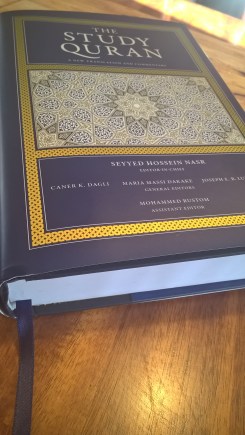
Those familiar with study editions of the Bible will found The Study Quran’s structure, binding and makeup fairly familiar. The entire text adds up to 1,988 onion skin style pages plus helpful maps at the back. There is also the familiar bookmark ribbon running down the middle in beautiful deep blue.

There is a nice heft to the book which has a beautiful cover featuring a a gold-look gilt Islamic design border and a blue and gold-gilt design in the centre. If you take off the paper cover you find a nice dark blue hard cover with the gilt-gold design again.
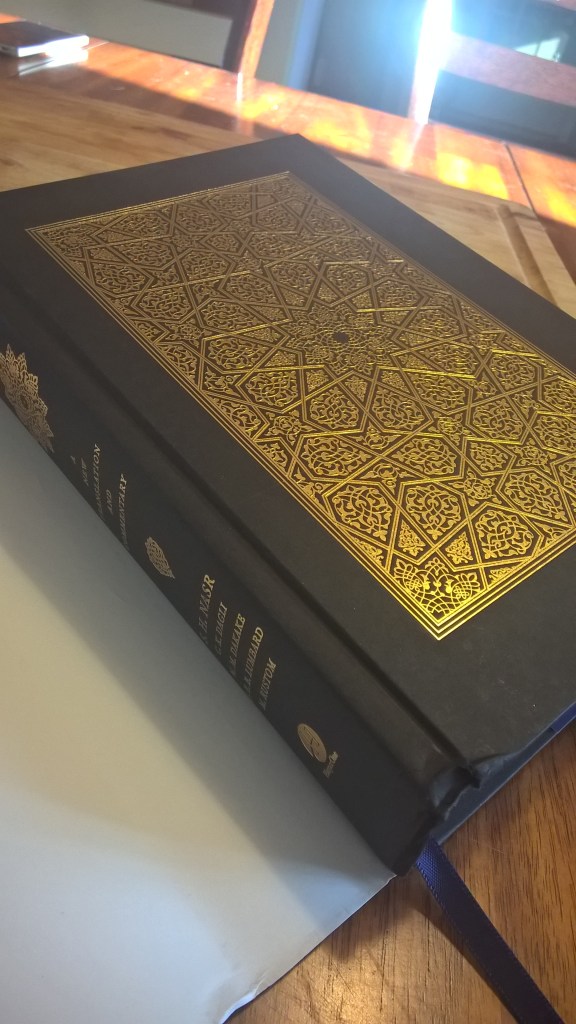
wp_20161113_13_17_10_rich

Open the cover and you find a typical Table of Contents, editorial information, Abbreviations, an Arabic Transliteration and Pronunciation table, followed by a General Introduction.

The General Introduction is further broken into subsections including The Message of the Quran; Language, Structure and Recitation; Role and Function in Islamic Life; The Study Quran; How to Read; Stylistic and Technical Points, Design and a Final Prayer.

Following these sections you find a small essay on approaching the Study Quran which talks about different ways of reading like reading the text alone; reading the text along with commentary, etc. There is also a small section on Understanding the Citations and a Commentator Key before one gets to the Quran proper.

One wp_20161113_13_19_08_richnotable difference between the Study Quran and a typical Study Bible is the amount of commentary. The introduction to the surahs (chapters or books for those not familiar with the Quran) are enormous to say the least. The first surah, The Opening or al-Fatihah as it is known in Arabic is only seven verses long but subject to six and a half pages of small font, two column, verse-by-verse commentary.
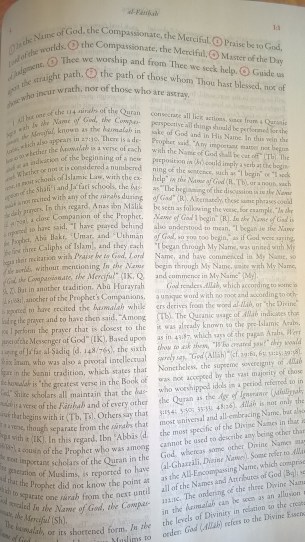
To say The Study Quran is thorough in terms of commentary and additional material would be an understatement.

Of course the voluminous nature of the commentary highlights the purpose of The Study Quran, which was almost a decade in the making – to provide a studious resource for both English or Arabic speakers either Muslim or non-Muslim; to be valuable to those who are doing deep study or for those with a more casual approach.

Contributors: The editor-in-chief of the work is Seyyed Hossein Nasr, university professor of Islamic Studies at George Washington University. Nasr. put together an editorial board made entirely of Muslim Islamic scholars of great repute who not only contributed to the commentary but also to the translation into English. That is to say the effort was led by those who were both scholars of significance and believers in the Quran as “the Word of God”.

Beyond the text of the Quran proper there is a section of no less than 18 essays on a wide variety of related subjects designed to assist and inform the reader including: How to Read the Quran, Scientific Commentary in the Quran, The Quran as a Source of Islamic Law, The Quran and Islamic Art, and Quranic Ethics, Human Rights and Society.

Liberal or Conservative? To do justice to such a question would require a much deeper knowledge of Islam and the Quran than I have or am prepared to delve into at this point. Suffice to say that the editors state the goal was to create a work that was “expressing traditional Islamic views and therefore excluding modernistic or fundamentalist interpretations that have appeared in parts of the Islamic world during the past two centuries….a text that reflects how Muslims have understood the Quran during their long history and how those Muslims who remain traditional, which means most of them, do so today.

The Difficult Verses

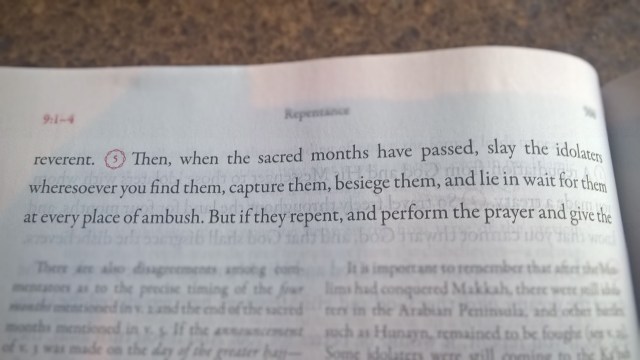
wp_20161113_16_12_32_pro_21

When I look at and review works of faith I like to go straight for the controversial verses to see how they are dealt with as this is often typical of the whole.

The fifth verse of the ninth surah is often referred to as the sword verse and its interpretation has caused no shortage of problems for Islam in the modern world – especially post 9/11.

It reads “Then, when the sacred months have passed, slay the idolaters whersoever you find them, capture them, besiege them, and lie in wait for them at every place of ambush.”

The verse has been accused of inciting violence against non-Muslims and as fuel for the fire of extremist Muslim terrorism.

Without re-writing the entirety of the commentary on verse five I will summarize. The commentary does a good job rooting the verse within the political strife of Islam and its prophet Muhammad during the seventh century C.E. Within this context the commentary suggests that Muslims traditionally see this verse as referring to past formative events and not as a broad rule for how to treat non-Muslims. Additionally the commentary points out other areas of the Quran that would contradict a broad interpretation that supports violence against non-Muslims today and it does so clearly and without literary contortions.

To wit from the commentary on the verse,

From the perspective of the Muslim community, the years of conflict preceding this announcement created a political environment where the idolaters of Arabia could not be left in a position of power and political strength to menace the Muslim community in the future;

This is one of the primary values of such a work for as much as it helps clarify and root controversial verses within the appropriate context for non-Muslims; it does so for Muslims as well.

In my own reading of the Bible, for instance, there are no end of verses that could be torn from their original context and used to justify horrific violence, not the least of which includes Psalm 137, verse nine which states:

Happy is the one who seizes your infants and dashes them against the rocks.

Horrific? Absolutely. Justification for murdering babies? Not even a little. Why? Context both literary and historical tells us this.

The Rest: The commentary is not simply the opinion of the contributors to The Study Quran but an amalgam of nearly 1,400 years of traditional commentary including Hadith or traditional reports and Tasfir or exegesis.

Appendix A is an ordered list of Hadith citations.

Appendix B is a Timeline of Major Events Related to the Quran from 570 C.E. to 651 C.E.

Appendix C is the Biographies of Commentators followed thankfully by an Index. There is nothing worse than a large and comprehensive work like The Study Quran coming without an Index. While comprehensive the index feels as if it could be more thorough.

Following the index are a series of helpful maps that help with an understanding of the historical context.
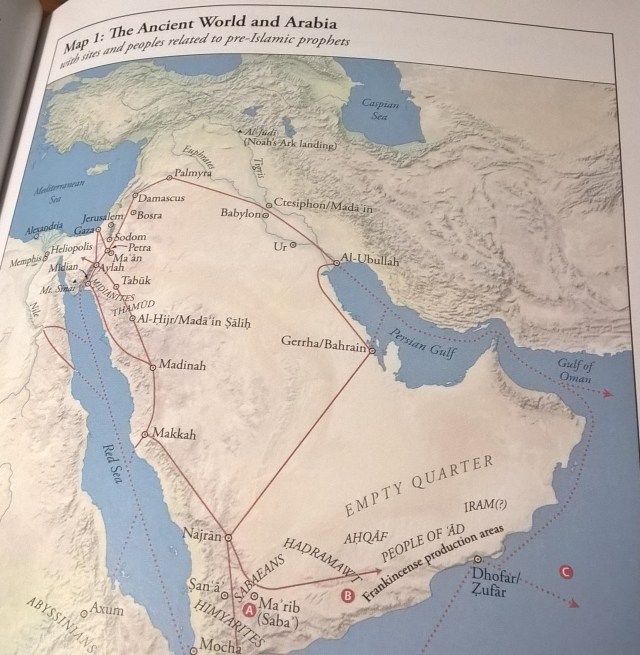
wp_20161113_18_41_18_pro

Conclusion: The Study Quran is a beautiful and thorough creation marrying the text of the Quran translated into English with a commitment to remain as close to the original Arabic meaning as possible and an exceptional deep commentary that seeks no extremes but rather a focus on longstanding Islamic tradition.

The Study Quran is a quality book that is simple to use and will provide much needed context and background to any reader be they laypeople, clergy, Muslim or non-Muslim.

In an age where misunderstanding between beliefs and cultures has fed violence, suffering and extremism The Study Quran is a welcome addition not just to the Islamic lexicon but to world literature.

breathe

breathe in love
breathe out despair
breathe in joy
breathe out lonely
breathe in freedom
breathe out anxiety
breathe in the light
breathe out the dark
breathe in laughter
breathe out the weeping
breathe in passion
breathe out the ashen grey
breathe in peace
breathe out conflict
breathe in I AM
breathe out I AM not

breathe in I AM not
breathe out I AM
breathe in conflict
breathe out peace
breathe in the ashen grey
breathe out passion
breathe in the weeping
breathe out laughter
breathe in the dark
breathe out the light
breathe in anxiety
breathe out freedom
breathe in lonely
breathe out joy
breathe in despair
breathe out love

The Body: Of Corporate Personhood

An interesting thing happens when two or more people gather together with purpose or intent – an organization forms, a kind of corporation. Nothing can be done about this – the organization forms whether you like it or not and that organization immediately begins to lose its human character.

While it feels inevitable, this loss of humanity that organizations tend towards, I don’t think it is…but it is hard work to keep it from happening.

One of the strict differences between organizations and typical human relations (families, friendships etc) is the tendency to over enforce roles and structure. While there are roles and structures related to human relations the primary enforcement of such things in institutions is a complex combination of things:

  • to maintain power where power should be maintained (or just power for power’s sake)
  • inflexible roles and hierarchy allow for an efficiency of task delineation but also for a “pass the buck” mentality to grow
  • complexity begets complexity that allows you to get intentionally or unintentionally lost in the system
  • systems become impersonal – quickly

One of the interesting things that both institutions and individuals have in common is an uncanny ability to blind themselves to their own issues.

A person can go their entire life without ever seeing and coming to terms with a particular flaw despite all the damage it produces in and around them. If anything institutions can be worse at this.

At a personal level, over enough time, evidence begins to mount that there is a persistent problem.

I have been in 17 relationships in the past 5 years and they all have ended badly” says one person.

With this in mind a person usually goes one of two ways:

  1. They assume they are simply cursed with terrible luck and that all 17 people they have been with have been at fault and they simply have to keep trying until finally the right person comes along.
  2. They recognize that, statistically speaking, there must be something within themselves that is contributing to an unhealthy pattern within relationships.

Number 1 is where our gravity wants to take us while number 2 requires a great deal of courage and humility; It requires one to turn the lens inward instead of outward.

Institutions often avoid number 2 like the plague. One reason for this is simply the complexity of the institution which leads to no one wanting to take responsibility for the soul searching, and often, no one has the authority to do so either.

New businesses often fall prey to this.

A new business opens in a community and for whatever reason it struggles to succeed. Often the first reflex of the small business is to blame the market/client base.

People are not shopping local; people are shopping during hours I am not open; people should be willing to pay higher prices for what I offer; if people only understood the value of my product they would patronize my business more often, etc, etc.

Of course while all of this may be true it does nothing to convince the client to come into the business. Unless the business changes itself things will not improve. Serious questions must be asked chief of which is “what must I do?

What must I do:

  • to bring in customers
  • to bring back customers
  • to grow my customer base

Answer these questions honestly and with keen insight into your local demographic and you will know what you need to do.

In loving human relations these are the questions that need to be asked as well and the answer to them tells us where to step next on the path ahead. Fear of these questions can lead to one walking blindly – right off a cliff if we’re not careful.

Probably the most important attribute of the human relationship that corporations and institutions (and people too) lose is the capacity to feel the loss of the other. When I say feel I mean REALLY feel it…feel it in a way that goes beyond looking for the person but actually stopping and asking why they left.

A company that sees a high turnover rate and allows it to continue without question is an unhealthy place. A company that assumes there must be a problem with the people leaving has deep flaws.

In a healthy human relationship turnover ideally does not occur except when children flee the nest for the skies so-to-speak. When ill winds blow however as they are wont to do from time to time we all (should) stop and look within to see what our role is in the storm that is brewing. We do this because we might be able to do something…at least about ourselves because ourselves are the only part of the family equation we can change…sometimes it is not enough but it is where we must go.

So to the corporation or institution must wonder in this way otherwise it becomes cold and unattractive; a lonely, echoey place that welcomes only the like-minded.

Ultimately to thrive as a corporation in the human world you must adopt those same principles and structures that people need to adopt to thrive in relation to one-another…otherwise you may fail, or worse still…simply exist.

this less tethered life

no strings attached
is a dreamed heaven

where

we either fall to the floor
or float off unbound;

either way we smile
to have achieved
the escape from strife
and the beautiful embrace of
this less tethered life