The Rage Against God Review

Peter Hitchens book is a thoughtful, compelling and artfully written story of one man’s journey from atheism back to faith. If you are expecting the acerbic, antagonistic wit of the elder brother Christopher Hitchens then you will be disappointed. Peter Hitchens writing is a gentle and fluid movement through an age of great change in the western world as seen through the eyes of his own life. There is a great appeal to twentieth century western history as Hitchens weaves a tale that shows the slow and steady march of the west away from Christianity and the not coincidental increase in its own corruption and increasing moral failure. Do not be mistaken, Hitchens is not writing an apology for Christianity and is often quite critical of certain decisions churches and Christians have made which seem to have hastened its own abandonment. Nevertheless what he does provide is a clear and personal account of some of the reasons for the abandonment and how it has led to the state the western world finds itself in now.

The book reads very quickly but is not an encyclopedic listing of why God is good and atheism is bad. Rather, Hitchens writes of an atheism born out of immature arrogance and a Christian faith reborn out of an increasing awareness that atheism was neither fulfilling nor honest.

The book would make an excellent book club selection and is sure to generate loads of discussion, especially as a counterpoint against Christopher Hitchens thoroughly well written book God is Not Great. I highly recommend it. Please note, whether you are an atheist, agnostic or faith-based person you will find this book enjoyable and insightful if for no other reason than it was written by a man raised in the same household, by the same parents and in the same cultural environment as the western world’s leading and loudest atheist voice today.

Rams & Rivers of Oil

the people of God
come to the altar
spreading the blood
of sacrificed time
the fruit and grains
of lost Sunday mornings
pour the wedding wine
of dollars given in faith
for the temple and the Levites
to live upon the fat
while excess flows below
to the valley of Kidron
to the garbage of  Gehenna

and so the cycle goes
an offering for a receiving
a sacrifice for a sin’s forgiving
while Micah,
voice of Lord weeps words unheard:

“He has shown you, O mortal, what is good.
And what does the LORD require of you?
To act justly and to love mercy
and to walk humbly with your God.”

Rock

and you…
you shall be rock
your roots shall run
to the core of the earth
not wind
nor rain
nor driving flood
nor covering seas
shall move you from your place

there is peace
there is joy
there is the unquenchable
when one is stone
through and through

A Mirror in the Dark

mockingbird consumes the world
every smile and laugh that passes
each twist of head and glint of eye
the frowns and cries
of every passerby

mockingbird tells stolen jokes
pick-pocketed from the unwary
and decorates his nest with neighbour’s eye

‘thank God for all of you’
is the only original call put forth
‘for what would i be without the other?’

nothing but a mirror in the dark

Our Father Who Art In Heaven

In a western culture that is increasingly secular humanist the words “our father who art in heaven” still ring with familiarity to a majority of people. These words are foundational. They are the beginning of the archetypal prayer for Christianity and as such it is not a surprise that iconoclasts chose to attack the Lord’s Prayer first in the humanist affront on Christianity in the public sphere. While all of this might be interesting it is not my primary point.

I want to talk about the plurality of the Lord’s Prayer. The Lord’s Prayer is offered in plurality as a prayer of many, a prayer of an assumed community. There is no ambiguity in the original Greek text of Matthew 6 which very clearly has the prayer being offered by many and never by one.

While this may seem obvious to some readers and while many may have had this epiphany long ago and wonder at what all the fuss is here, I can honestly say that it had never occurred to me until last night while I was praying that this prayer is a communal prayer.

Let us look to the context within which we find the prayer in Matthew. The prayer is presented as instruction and part of the Sermon on the Mount. Christ informs those listening to him in Matthew 6:5-8

“And when you pray, do not be like the hypocrites, for they love to pray standing in the synagogues and on the street corners to be seen by others. Truly I tell you, they have received their reward in full. But when you pray, go into your room, close the door and pray to your Father, who is unseen. Then your Father, who sees what is done in secret, will reward you. And when you pray, do not keep on babbling like pagans, for they think they will be heard because of their many words. Do not be like them, for your Father knows what you need before you ask him.”

Jesus scorns the publicity of prayer designed not so much for the Father as for those in the public square to see and hear the piety and righteousness of the one who prayers. Essentially Jesus says that to avoid the temptation of praying for the sake of being heard by the community, go and prayer alone in isolation. There is irony here because if there is any time to pray in plural to “our” Father it is when you are in the public square and others are listening. Jesus presents us with a great reversal…he says that when we pray in public we are often in prayer alone for ourselves with selfish motivations (note: public prayer is not inherently wrong…Jesus, as so often happens, is concerned with heart).

After solidly isolating the ostentatious prayer and the one who prays it as alone and outside of community Jesus then provides the appropriate prayer to be said in isolation and away from the masses in Matthew 6:9-13:

“‘Our Father in heaven,
hallowed be your name,
your kingdom come,
your will be done,
on earth as it is in heaven.
Give us today our daily bread.
And forgive us our debts,
as we also have forgiven our debtors.
And lead us not into temptation,
but deliver us from the evil one.”

We immediately notice that this prayer is not my father, give me today and forgive me my debts as I have forgiven and lead me not into temptation but deliver me…”; the prayer is solidly rooted in community and so therefore the one who prayers, while alone, is never alone but has in fact joined themselves through the unity of the Holy Spirit to the community of faith throughout heaven and earth.

The Lord’s Prayer teaches us that there is no ‘I’ in Jesus, there is only ‘us’. The modern and post-modern western reader will struggle to accept this because we have lived through an age of “personal salvation” where the emphasis is selfishly on saving ourselves first and foremost. We are told Christ came for me, I, you…than the world. Our age is one of selfishness and self-centredness rooted in the individual ego that thinks first of itself and then, if there is time, of others.

With the Lord’s Prayer Christ tells us we are never more alone than when we seek to stand before others and declare our righteousness before God through our public piety and we are never more in community then when we seek our hidden spaces and lift voices up to OUR Father. The prayer becomes a prayer for US and not simply for me. It becomes strong inasmuch as it is one of many threads wound together to form an unbreakable rope lifted to heaven.

In praying the Lord’s Prayer we cannot pray only for ourselves…it is not possible. If we pray only for ourselves we may find it easy to hate others but it is not possible to hate the person you genuinely pray for…and so if we pray as we are instructed, for US, in community, we are making it harder for hostility to develop between ourselves those who are a part of US and OUR. In that sense the prayer reminds us of the those powerful verses in Ephesians 2:13-20 that say:

“But now in Christ Jesus you who once were far away have been brought near by the blood of Christ.

For he himself is our peace, who has made the two groups one and has destroyed the barrier, the dividing wall of hostility, by setting aside in his flesh the law with its commands and regulations. His purpose was to create in himself one new humanity out of the two, thus making peace, and in one body to reconcile both of them to God through the cross, by which he put to death their hostility. He came and preached peace to you who were far away and peace to those who were near. For through him we both have access to the Father by one Spirit.

Consequently, you are no longer foreigners and strangers, but fellow citizens with God’s people and also members of his household, built on the foundation of the apostles and prophets, with Christ Jesus himself as the chief cornerstone.”

More importantly when Christ gives us the Lord’s Prayer he is not saying “here is a prayer you can pray if you don’t know what to say” as if it were one of many. He says in Matthew 6:9 – “This, then, is how you should pray…” The Lord’s Prayer is the model for prayer and that model is solidly rooted in the community of faith. We are reminded through the prayer of Saint Paul’s words in 1 Corinthians 10:13 when he says:

No temptation has overtaken you except what is common to mankind. And God is faithful; he will not let you be tempted beyond what you can bear. But when you are tempted, he will also provide a way out so that you can endure it.”

We pray that God would deliver US because none of us is unique in our temptations but all are struggling with the problem of evil in the world. The Lord’s Prayer is a great equalizer because it will not allow any of us to elevate our struggles above our neighbour. It will not allow any of us to elevate our neighbour’s sin above our own. The prayer reminds us that we are all in this together.
Snow Devils

snow devils spin
a dervish dance
whirling wild white
outside the window
unfettered
unbound
entropic purpose
like fractal dancers
in Winter’s wicked ballet
to the music of the wind,
this banshee wind

This Human Zoo

whither and where thy words fly
why, oh why, oh why the need
for shreds like garbage-garments
thrown away only to be picked up again
‘look oh look!’ in constructed shock
at the horror that is he and his
a sad pathetic zoo of human failure
where the monkeys make fun of the apes
for the quality of their enslavement

and from cage to cage it goes ever on
the joy at neighbour’s miserable bondage
makes ones own chains slightly lighter
lifted by the airy whispered uncoverings of

“have you heard?” and “did you know?”

lost amid the thousand, thousand voices
crazed cacophonous crying
seeking sanctified solace in the  primal impulse
to rage against their pain
through the wearing
of the cloak of other’s shame…

Isabella Rises

Isabella rises morning sun bright
and in this soot-dark winter home
each glance
each word
a spreading joy-filled light

Quod Est Veritas?

What is truth?

Pilate asks this question of Christ as he stood before him and it echoes the deepest of human longings. We long to know…we long for truth but ultimately we have no idea what it is when we see it. Pilate is the perfect example of this. He represents the most powerful empire the world had ever seen (and likely will ever see). In Pilate’s question we sense cynicism…the cynicism of the modern age millenia before it comes to pass.

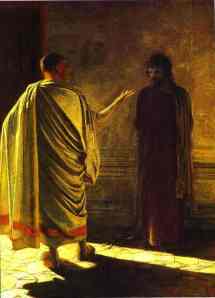
There is a great painting by Russian artist Nikolay Ge that captures the scene very well I think (see below). In it Christ, who represents truth, stands obscured in the shadows while Pilate, who represents the pinnacle of human endeavor (Rome) stands in the light…the painting portrays the great irony of humanity questioning God about truth and doubting its existence when it is staring them directly in the face.

The question from Pilate is located in John 18:

“You are a king, then!” said Pilate.

Jesus answered, “You say that I am a king. In fact, the reason I was born and came into the world is to testify to the truth. Everyone on the side of truth listens to me.”

“What is truth?” retorted Pilate. With this he went out again to the Jews gathered there and said, “I find no basis for a charge against him.

Pilate gives Christ no opportunity to respond because he does not care to hear his response. This is typical of the jaded who have already decided there is no such thing as the truth. Christ of course has already responded to the question when he speaks with Thomas in John 14:

Thomas said to him, “Lord, we don’t know where you are going, so how can we know the way?”

Jesus answered, “I am the way and the truth and the life. No one comes to the Father except through me. If you really know me, you will know my Father as well. From now on, you do know him and have seen him.”

The truth stands before Pilate and he remains blind to it. We all tend to be blind to the truth. How many times have we seen or heard truth in our lives and simply decided to ignore it or worse still believe a lie instead? There is only one truth by which all other truth is measured and that is Christ. People will always believe what they want to just as Pilate believed what he wanted to…that there was no such thing as truth. When given the opportunity to tabernacle with God in the garden or eat from the tree of the knowledge of good and evil we pick the tree thinking it will teach us more about truth when in fact it simply blinds us to it instead.

Our challenge if we want to know “the truth” in any circumstance is to resist the urge to run to the tree and instead look to Christ. He may very well simply say “I am the truth” and it will have to be enough even when we feel we want to know more or believe otherwise.

"Quod Est Veritas?" Christ and Pilate 1890